From Farm to Factory: The Complete Jute Manufacturing Process
October 24, 2026 · Jute Bag Factory
Jute — the golden fibre — is cultivated, harvested at flowering, retted, graded, then carded, spun and woven before bags are cut, stitched and printed. Jute Bag Factory finishes wholesale orders in-house with OEKO-TEX water-based inks, custom sizes and a GST invoice.
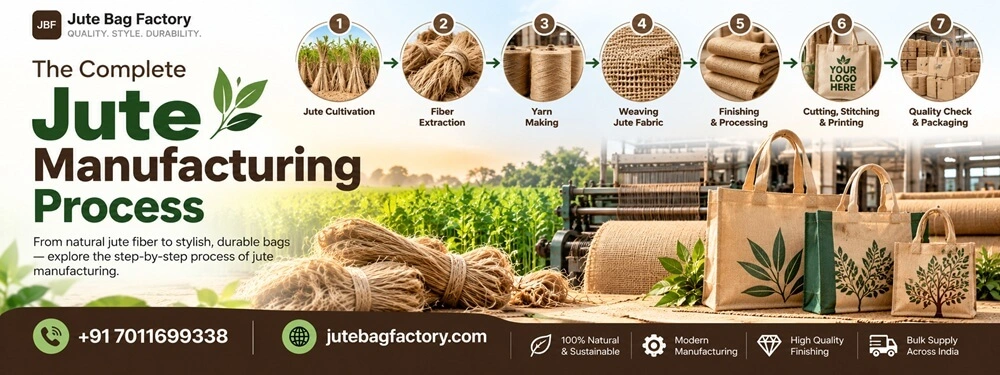
Jute is the golden fibre of sustainable packaging: high tensile strength, fully biodegradable, and grown with little irrigation. A wholesale bag is not stamped from plastic sheet — it is cultivated, retted, graded, spun, woven, printed and stitched. Knowing that pipeline helps buyers judge GSM, print safety, MOQ and lead time.
Where the golden fibre is grown
Soil, climate and harvest window decide fibre length and lustre before any mill sees the crop. South Asia supplies almost all commercial jute.
- Temperature 24–37°C in a warm tropical climate
- High seasonal rainfall and humidity
- Fertile, water-retentive alluvial soil on river floodplains
- Sown March–May; harvested July–October
| Country | Share of crop | What mills buy it for |
|---|---|---|
| Bangladesh | 70%+ | Fine, shiny, high-tensile golden jute |
| India | 20%+ | Large-scale mill output and finished bags |
| Nepal, Thailand, Myanmar | ~10% | Regional specialised crops |
The jute industry in India — crop context, not our factory
This clip from The Hindu is industry context — how jute is grown and milled in India, and why the crop still matters. It is not a tour of Jute Bag Factory. Our work starts after fibre and cloth reach the factory: cut, stitch, OEKO-TEX print and QC.
The six-step jute manufacturing process
From delta farms to packed cartons, Jute Bag Factory follows the same sequence for shopping, promotional and specialty bags. Jump to a stage, or scan the map below.
| Step | Stage | What you get |
|---|---|---|
| 1 | Harvesting & traditional retting | Sun-dried golden jute fibre |
| 2 | Farm-to-mill transport | Graded fibre at the mill |
| 3 | Fibre processing, spinning & weaving | Jute fabric rolls, plain or eco-dyed |
| 4 | Eco-friendly screen printing | Printed bag panels |
| 5 | Precision stitching & tailoring | Finished bag body and handles |
| 6 | Quality control & dispatch | Packed wholesale order with tracking |
Watch the farm-to-mill process
This mill-side film from Our Collection shows cultivation through spinning and weaving — the farm-to-mill half of the pipeline. Jute Bag Factory does not use this as a factory video. Print, stitch and QC in steps 4–6 below are our in-house bag line.
Step 1: Harvesting & traditional retting
The journey starts in fertile delta regions where jute plants grow with little rainfall and without chemical fertilisers. Plants are cut at the right maturity, bundled, and submerged in slow-moving water — the traditional process called retting.
- The science of retting: natural microbes loosen the outer bark and dissolve the sticky resins that bind the golden fibres.
- Separation: local farmers strip the fibre cleanly from the stalk once retting is complete.
- Sun drying: raw jute strips are air-dried in natural sunlight to lock in tensile strength and lustre.
Poor retting shows up later as weak yarn and dusty fabric. That is why grade, colour and fibre length are checked again at the mill — not only in the field.
Retting methods compared
Water retting is still the quality benchmark for golden fibre. Faster methods trade speed for strength or cost.
| Method | How it works | Advantage | Trade-off |
|---|---|---|---|
| Water retting | Bundles submerged in ponds or slow-moving rivers | Traditional golden fibre quality | Needs clean water; organic load if unmanaged |
| Mechanical | Rollers crush the stalk | Faster | Can cut tensile strength |
| Chemical / enzyme | Solutions speed gum breakdown | Rapid | Costlier; fibre risk if overdosed |
| Microbial | Selected bacterial strains, typically 4–6 days | Lower water use | Not yet universal at farm scale |
For why the fibre itself is a plastic alternative, see why eco-friendly jute bags replace plastic.
Step 2: Farm-to-mill transportation
Sustainability is built into the supply chain before any bag is cut.
- Local cooperatives: dried golden fibre is bundled and loaded onto lorries by farmers and community groups.
- Direct logistics: material moves to the processing mill without extra trader hops, which shortens miles and supports rural livelihoods.
- Traceable lots: fibre is kept in graded lots so shopping-bag GSM and promotional-bag colour stay consistent across a wholesale run.
Jute fibre grades (TD-1 to TD-8)
Ask which TD grade a quote is built on. Premium shopping bags should not be cut from sacking fibre.
| Grade | Look | Typical use |
|---|---|---|
| TD-1 to TD-3 | Bright golden, long, fine | Premium shopping bags and fine cloth |
| TD-4 to TD-6 | Medium colour and fineness | Standard hessian, utility bags, ropes |
| TD-7 to TD-8 | Coarser, shorter fibre | Heavy sacking and rough packing |
Step 3: Fibre processing, spinning and weaving
At the mill the raw fibre is turned into cloth through a mechanical sequence buyers should recognise on a factory tour.
- Softening & conditioning with moisture and approved agents
- Carding into uniform slivers
- Drawing frames to blend and even the sliver
- Spinning to the yarn count needed for bags vs heavier cloth
- Winding and beaming for the loom
Weave (typically 13×13 to 14×15) and GSM decide how a shopping tote or promotional bag will carry load. Ask for those numbers on every quote — they matter more than a stock photo.
Hessian, sacking or canvas?
The weave name on a spec sheet tells you what the bag is for. Most retail and promotional orders use hessian.
| Cloth | Feel | Best for |
|---|---|---|
| Hessian (burlap) | Lightweight, breathable weave | Shopping bags, promotional totes, light retail |
| Sacking | Heavy, coarse weave | Agricultural and industrial sacks |
| Canvas | Tight, dense weave | Structured luxury bags and heavy-duty items |
After weaving, fabric can take a finish before cutting:
- Bleaching or eco-dye for brand colour
- Calendering for a smoother, glossier face
- Thin eco-laminate or waterproof backing when contents need moisture protection
- Flame-retardant finish only when a brief specifies indoor/industrial safety
Step 4: Eco-friendly screen printing (OEKO-TEX approved)
Custom logo printing is part of the manufacturing line, not an afterthought. Branding should never undo the fibre’s environmental story.

- Bespoke artwork: logos, patterns and campaign art are screen-printed onto bag panels.
- Safe inks: OEKO-TEX approved, water-based inks — no heavy-metal residues, suitable for daily consumer handling.
- Other methods: block print and embroidery are available when the artwork needs texture rather than a flat colour flood.
Event and corporate buyers can compare methods in custom branding on jute bags for corporate events.
Step 5: Precision stitching and tailoring
Printed panels move to the stitching floor, where size and handle style are locked in.
- Custom sizing: length, width, gusset and handle drop follow the spec sheet, not a one-size pattern.
- Retail totes: jute shopping bags and tote bags for grocery and fashion.
- Specialty shapes: wine bags, grocery carriers and promotional pouches.
Because cutting and stitching sit in the same factory as printing, a change in gusset or handle does not wait on a third-party unit.
Step 6: Quality control and dispatch
No batch ships until it clears the same gates. That is what a factory-direct label is supposed to mean.
| QC check | What we look for | Why buyers care |
|---|---|---|
| Tensile strength | Yarn and handles take load without seam slip | Bags carry 8–15 kg in daily retail use |
| Stitch integrity | Even SPI, locked corners, handle bartacks | Fewer returns after the first heavy shop |
| Print precision | Register, colour match, no bleed | Logo looks the same on bag 1 and bag 500 |
| Dimensions | Size, gusset and handle drop vs the spec | Cartons nest; retail fixtures still fit |
| Pack & paperwork | Counted, bundled, GST invoice, tracking | Accounts-ready wholesale delivery |
Approved bags are packed and sent to the delivery city. Typical production is 7–15 days after artwork sign-off, then courier transit. If you are still choosing a supplier, use the 10-point manufacturer checklist — a real factory can talk through these six steps without hand-waving.
Why jute manufacturing is a low-impact crop
Jute is often called the fibre of the future because the plant does the climate work before the bag is even cut.
- 100% biodegradable and compostable — unlaminated bags leave no synthetic microplastics
- About 15 tonnes of CO₂ absorbed and 11 tonnes of oxygen released per hectare while the crop grows
- Low irrigation and little need for synthetic fertiliser or heavy pesticides
- Leaf and root matter left in the field enriches soil for the next crop
What this process means for a bulk order
- Ask for GSM, weave and print method on the quote, not only a unit price.
- Request a pre-production sample after artwork approval.
- Confirm MOQ (most bags from 100 pcs) and a written 7–15 day production window.
- Insist on a GST invoice and tracking on dispatch.
Frequently Asked Questions
Need bags from this production line?
Factory-direct wholesale jute bags with custom branding — MOQ from 100 pieces, GST invoice, pan-India dispatch.